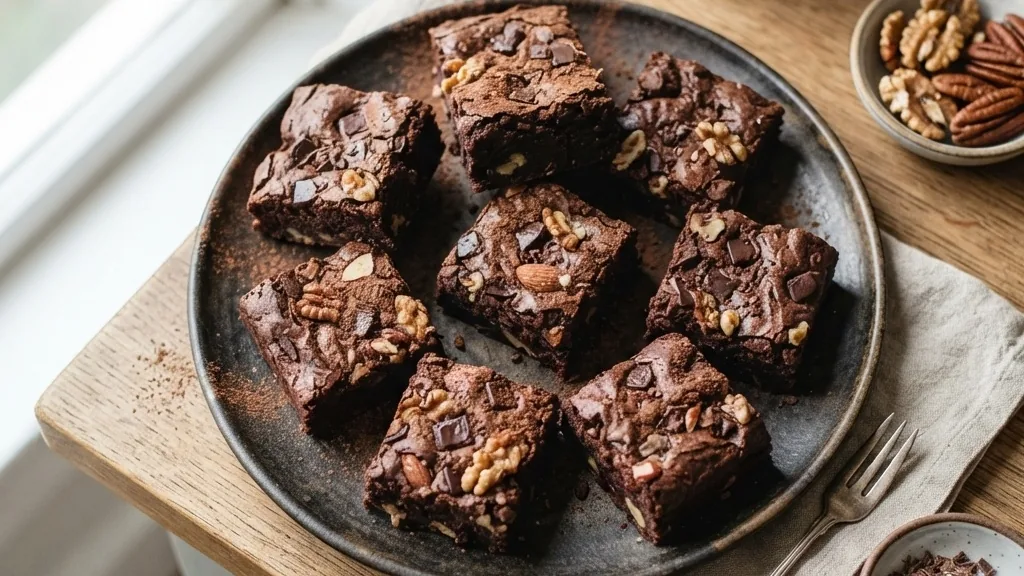
Protein brownies fail the same way in almost every kitchen: dry, rubbery, or chalky, with a protein claim nobody bothered to check against the label rules. The fix is not another splash of milk. It is understanding that protein powder binds water and adds no starch, that whey sets before your crumb finishes, and that the number on the front of the pan almost never survives the math. The exact phrase people search is protein brownies, and the version that wins clears 10 g of usable protein without tasting like a chalk stick. That is the recipe, the science, and the troubleshooting below, built from USDA FoodData Central composition data and the FDA rules that govern what “high protein” is even allowed to mean.
Quick answer: Good protein brownies start with eggs and Greek yogurt for high-quality protein, then use whey isolate to reach 10 g per serving. Bake at 350F in an 8×8 pan for roughly 20 minutes, not the 25 to 30 many recipes print, because whey denatures above 65C and overbaking is the number one failure. To claim “high protein” a serving needs 10 g PDCAAS-corrected, which is 20 percent of the 50 g Daily Value. Pea protein at PDCAAS 0.7 and collagen at PDCAAS 0 both fall short of raw-gram promises.
The Protein Powder Substitution Matrix Nobody Publishes
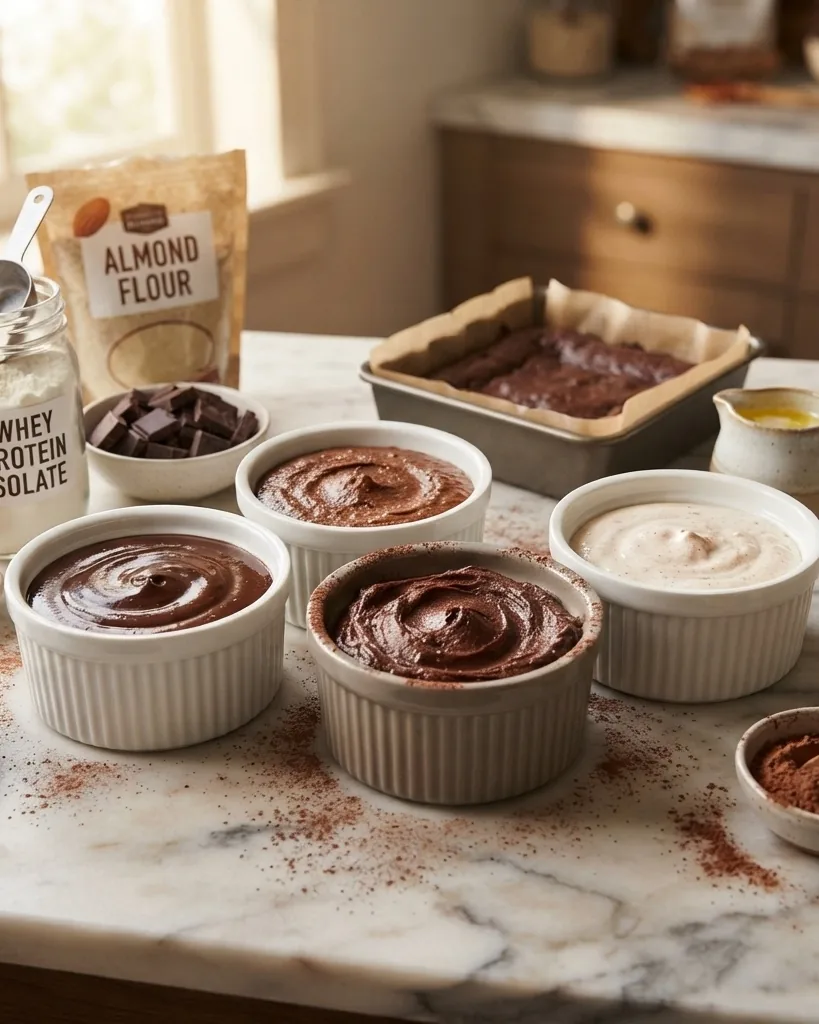
Different protein powders behave completely differently in a brownie batter, and the liquid you add depends entirely on which one you reach for. Whey isolate absorbs less water and sets fast; pea protein drinks liquid and turns batter unspreadable; collagen dissolves invisibly but does nothing for muscle. The top recipes admit this in a comment reply and then hand you a single generic instruction. Below is the working version, with liquid adjustment, texture, and the protein that actually counts after the PDCAAS correction against the 50 g Daily Value.
- Whey isolate (PDCAAS ~1.0): add the least liquid, drop oven temp about 25F, bake shortest. Cleanest flavour, best 10 g target route.
- Whey concentrate (PDCAAS ~1.0): absorbs roughly 1.5x its weight in water; add a touch more liquid than isolate.
- Casein: thickens hard and holds water; expect a denser, cakier crumb and add extra milk.
- Pea protein (PDCAAS ~0.7): highest water uptake, unspreadable if under-hydrated; 7 g raw is only about 4.9 g corrected.
- Rice and pea blend: milder than pea alone, still liquid-hungry.
- Egg white protein: high quality, can rubberise; treat like whey on timing.
- Soy protein: high quality (PDCAAS near 1.0), slightly beany.
- Collagen (PDCAAS 0): dissolves beautifully, adds zero usable protein for muscle. This will not build muscle.
Collagen deserves its own flag because it is listed as an option all over the search results with no warning. It contains no tryptophan, which drops its limiting-amino-acid score to zero, and its leucine content sits near 2.5 percent by weight against whey’s roughly 10 to 11 percent. On a US label, collagen grams legally cannot count toward the protein Daily Value. For fudginess and structure it is fine; for the word “protein” on the tin it is a mirage.
How Much Protein Is Really In One Brownie
One brownie is a snack, not a post-workout dose, and the honest number matters more than the headline. The protein Daily Value is 50 g. To label something a “good source” you need 10 to 19 percent DV, which is 5 to 9.5 g PDCAAS-corrected per serving. To say “high protein” or “excellent source” you need at least 20 percent DV, or 10 g corrected. The correction is not optional accounting; the FDA requires %DV to be calculated as grams times PDCAAS, divided by 50 g, under 21 CFR 101.9(c)(7) and 21 CFR 101.54. That single rule guts most claims in the category.
Run the incumbents through it. Eating Bird Food lists 7 g per brownie, but with pea protein at PDCAAS 0.7 that is roughly 4.9 g corrected, under 10 percent DV and short of even a “good source” claim. Chocolate Covered Katie promises “up to 15 g protein each” with no per-variant panel behind it. Eat With Clarity clocks 6 g per brownie.
The cheapest lever is the one everybody skips: eggs. Eat With Clarity notes its 3 eggs add 18 g of protein to the whole pan, and USDA FoodData Central puts a large egg near 6 g at PDCAAS 1.0. Greek yogurt and cottage cheese pile on more high-quality protein without the chalk. Eggs plus Greek yogurt plus whey isolate is the realistic route to a genuine 10 g per serving.
Context keeps you honest. The Recommended Dietary Allowance from the National Academies of Sciences, Engineering, and Medicine is 0.8 g per kilogram per day for adults, with an Acceptable Macronutrient Distribution Range of 10 to 35 percent of energy from protein. The International Society of Sports Nutrition 2017 position stand pushes higher for exercising people: 1.4 to 2.0 g per kilogram per day, with 20 to 40 g per feeding and 700 to 3000 mg of leucine per dose. One brownie does not hit a per-dose target. It is a treat that happens to carry real protein.
The Food Science That Keeps Them Fudgy
Protein powder dries baked goods because it binds water aggressively and brings no gluten or starch to gelatinise, so it competes with your flour for hydration and wins. That is the mechanism behind nearly every dry-brownie complaint. Whey makes it worse on a second front: whey proteins have poor thermal stability, with denaturation beginning above 65C and reported complete at 78C after 30 minutes. Every oven brownie bakes at 163 to 177C, so the whey sets early, stiffens, and gives you that rubbery edge before the crumb has finished. Denaturation changes the protein’s shape, not its amino acids, so the nutrition survives even as the texture suffers.
Fat is your fudginess lever. Melted chocolate carries more richness than cocoa plus oil, and it is one reason Eat With Clarity’s melted-chocolate method reads as fudgy. Sugar is structural too, not just sweet; it acts as a humectant, so cutting it more than about 25 percent changes texture, not only flavour. That is why sugar-free rebuilds so often turn out dry and crumbly.
Cocoa choice interacts with your leavening. Natural cocoa runs acidic at pH 5.0 to 5.8; light-alkalised (Dutch) sits at 6.8 to 7.2, medium 7.2 to 7.6, heavy 7.6 to 8.2, and black cocoa up to about 9.0. Baking soda is near pH 8.3 and needs an acid plus water to react. Natural cocoa can be that acid; Dutch cannot. If you swap natural for Dutch, drop the baking soda and use twice the baking powder; swap Dutch for natural and drop the powder for half as much soda. In a fudgy brownie with no chemical leavener, the two are interchangeable and the choice is only colour and flavour. A quick field test settles it: stir 1 teaspoon of cocoa into 2 teaspoons of distilled water, per Iowa State University Extension AnswerLine, and purple-red means natural while chocolate-brown means Dutched.
For deeper background on how melted chocolate and cocoa behave in dessert bakes, the technique breakdowns at Serious Eats are a reliable outside reference. And if a dairy-free crumb is the goal, the melted-chocolate logic transfers cleanly to these Fudgy Vegan Avocado Brownies, where the fat comes from avocado instead of butter.
Troubleshooting: Symptom, Cause, Fix
Most protein brownie failures trace back to one of eight symptoms, and each has a mechanism rather than a vibe. The stock advice (“don’t overbake,” “add a splash more milk”) treats the symptom without naming the cause, which is why the same failures repeat across comment sections. Match your result to the list below, then fix the cause, not the surface. The biggest single culprit is overbaking: multiple readers across multiple recipes report doneness at 20 minutes against published 25 to 30 minute windows, meaning the printed times are drying people’s brownies before the timer even goes off.
- Dry or crumbly: protein powder bound the water with no starch to hold structure. Add liquid, cut the powder, pull them earlier.
- Rubbery or bouncy: whey denatured above 65C and set before the crumb finished. Drop oven temp about 25F and shorten the bake.
- Chalky or gritty: too much powder relative to fat and flour. Replace only about one third of the flour with protein.
- Bitter or artificial aftertaste: protein-powder notes unburied. Add espresso powder, a salt bloom, and dark cocoa.
- Did not set or gummy centre: underbaked or too much wet ingredient for the dry.
- Batter too thick to spread: pea protein’s high water uptake; add liquid in small increments until spreadable.
- Sank in the middle: overleavened or opened oven early.
- Stuck to the pan: protein powders are notably sticky; line with parchment, do not just grease.
Doneness should never be a clock. Look for edges pulling from the pan, a centre that is set with a slight jiggle, and a toothpick that comes out with moist crumbs rather than clean. Then cool completely before cutting. Cooling sets the structure, gives a cleaner cut, and lets flavour develop, which is why every top recipe says to do it and none explains why. Carryover cooking keeps working after the pan leaves the oven, so pulling at moist-crumb stage is correct, not underdone.
Homemade Versus Store-Bought, And The Cocoa Nobody Discusses
Homemade protein brownies win on ingredient control and honest labelling, and they let you sidestep a safety question the whole category ignores: heavy metals in cocoa. Every recipe here calls for a quarter to a half cup of cocoa powder, the single most heavy-metal-dense ingredient in a home kitchen, and not one popular result mentions it. That is not a reason to panic. It is a reason to know the numbers and buy accordingly, because the difference between cocoa powder and milk chocolate chips is real and measurable.
California’s Office of Environmental Health Hazard Assessment sets Maximum Allowable Dose Levels that trigger Proposition 65 warning labels: lead at 0.5 micrograms per day, cadmium at 4.1 micrograms per day, arsenic at 10 micrograms per day. These are labelling triggers set at roughly 1/1000 of the no-observed-adverse-effect level, not food-safety limits, and saying so plainly matters. For dietary lead the FDA Interim Reference Levels are 2.2 micrograms per day for children and 8.8 micrograms per day for women of childbearing age.
Consumer Reports tested 28 dark chocolate bars in December 2022 and found 23 exceeded the MADL for at least one metal, with Perugina 85% Premium Dark measuring 539 percent of the daily lead threshold. Their October 2023 round covered 48 products including cocoa powder, chocolate chips, and brownie mixes; 16 exceeded the levels of concern, none of the five milk chocolate bars exceeded for either metal, and only 2 of 12 chocolate chip products exceeded, for lead. A pooled analysis of 72 cocoa products from 2014 to 2022 in Frontiers in Nutrition found 43 percent over the lead MADL and 35 percent over the cadmium MADL, but 97.2 percent fell below the FDA lead Interim Reference Level, and organic products tested higher, not lower.
Balance it. The National Confectioners Association disputes that MADLs are food-safety standards, and toxicologist Andrew Stolbach has said that at moderate consumption these levels are not a concern. The FDA’s Closer to Zero initiative is separately developing maximum heavy-metal limits for foods commonly eaten by children, chocolate included. Practical takeaway: milk chocolate and chocolate chips test lower than dark bars and cocoa powder, so a chip-forward brownie is the safer default, and moderate portions keep you well under the reference levels either way.
On protein-powder purity, the correct answer to “which powder is clean” is third-party certification: look for NSF Certified for Sport or Informed Sport on the tub. For the underlying protein-quality methodology, the FAO established PDCAAS in its 1991 report, which the FDA adopted by reference, and a 2013 FAO expert consultation proposed DIAAS as the successor using ileal digestibility. If you want a meat-based protein comparison for your daily total, the numbers in this filet mignon nutrition breakdown show how a whole-food source stacks up against a scoop of powder.
Storage, Meal Prep, And Diet Swaps
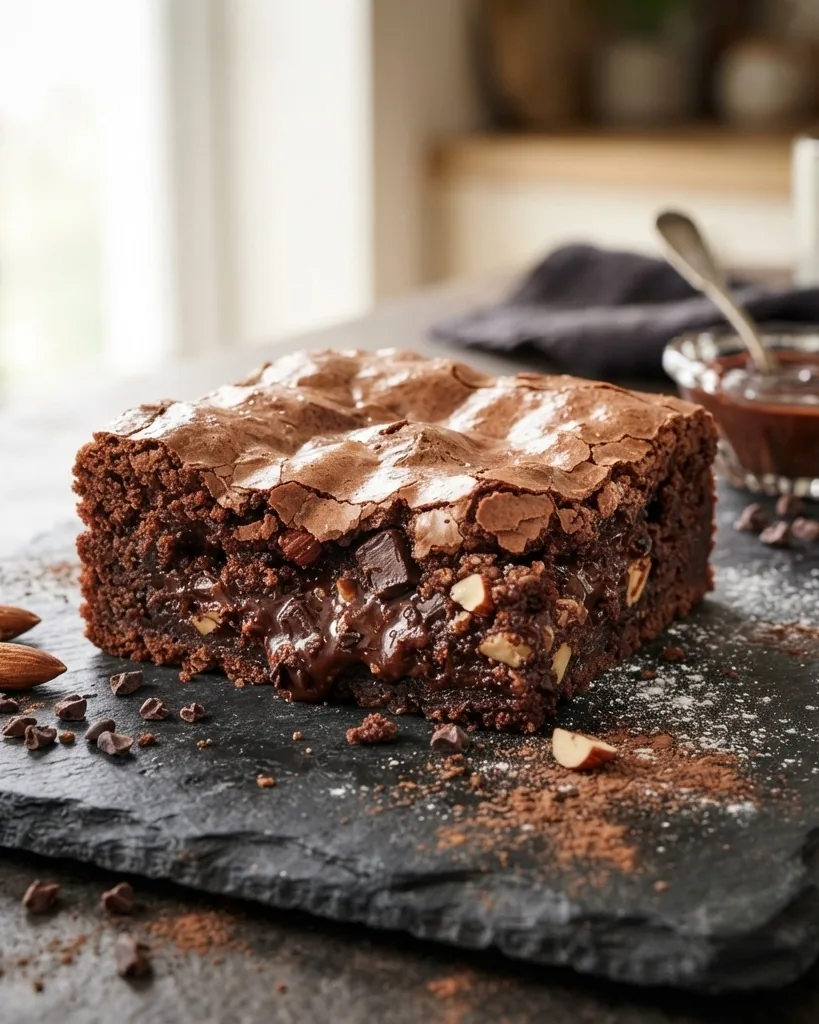
Protein brownies keep well and often taste better on day two, once the crumb sets and the flavour rounds out. Store them 3 to 4 days at room temperature, up to a week in the fridge, and up to 3 months in the freezer, which mirrors the windows the top recipes agree on. Reheat gently and briefly so the protein does not tighten and dry further. If you are baking a batch specifically for the week, cut and layer with parchment before chilling so they release cleanly.
Diet swaps are straightforward once you respect the levers. For egg-free or vegan, a flax egg replaces the binding but you lose the cheapest high-quality protein, so lean on soy or pea powder and expect to add liquid. For nut-free, skip almond-butter bases entirely. For gluten-free, an almond-flour base works; note that whole wheat, coconut, and spelt flours are frequently untested in these recipes, so treat swaps as experiments. For sugar-free or keto, allulose and monk fruit sweeten without the humectant role sugar plays, so accept a drier crumb. A no-bake or single-serve mug version skips the denaturation problem entirely, which is why they rarely turn rubbery.
If banana-based recipes tempt you, know the tradeoff: banana is a flavour liability that reads as banana bread, not brownie, and swapping it for pumpkin puree or applesauce means you must then add sweetener back. For a genuinely festive spin that keeps brownie character intact, this peppermint brownie ice cream cake shows how to build flavour without leaning on fruit.
Building Your Nutrition Panel The Honest Way
Skip the plugin auto-calculator and build the nutrition panel by hand from USDA FoodData Central, then say you did. Auto-calculators inherit whatever a database guesses about your specific brands, and every incumrent leans on them behind a disclaimer. Pull composition data for cocoa powder, eggs, almond butter, Greek yogurt, and maple syrup directly, sum the batch, divide by your serving count, and apply the PDCAAS correction to the protein line. That last step is what separates a defensible panel from a marketing number.
Set your targets against the field. Eating Bird Food publishes 165 kcal, 7 g protein, 15 g carb, 10 g fat, 3 g fiber, and 8 g sugar per brownie from a 16-serving 8×8 pan. Eat With Clarity runs 220 kcal, 6 g protein, 17 g carb, 16 g fat, 8 g sat fat, 2 g fiber, and 11 g sugar. Whitakers in the UK lists 190 kcal each for 9 servings from a 20×20 cm tin at 175C in under 30 minutes. A brownie worth writing home about beats all three: at least 10 g protein, no more than 200 kcal, and no more than 10 g sugar per serving, with the PDCAAS-corrected figure shown alongside the raw grams so nobody is misled.
Practical formulation guidance for working whey into a bake: replace roughly one third of the flour with protein, add a quarter to a half cup of a wet ingredient per cup of dry, and drop the oven temperature about 25F from the original. That guidance is trade-tier rather than peer-reviewed, so treat it as a starting point and adjust to your crumb. For the leavening interplay behind cocoa selection, the tested explanations at America’s Test Kitchen line up with the pH bands above.
Where Protein Brownies Fit In A Real Week
A protein brownie is a smarter dessert, not a meal, and it slots best where you would otherwise reach for something with zero nutritional return. Two brownies after a workout will not hit the 20 to 40 g per-feeding target from the ISSN position stand, but one alongside a Greek-yogurt breakfast closes a gap without a chalky shake. The point of the higher-protein build is not to pretend a treat is a supplement; it is to make the treat carry its weight so the rest of your day has more room.
They pair naturally with a protein-forward eating pattern. If your baking sits inside a broader meal-prep habit, the batch logic here mirrors what makes savory prep work, and a system like the one in Easy Meals Under 30 Minutes: The System, the Recipes, and the Safe Temps keeps the whole week honest on time and temperature. For a lean protein anchor at dinner, One-Pan Chicken Cacciatore covers the main while the brownies handle dessert, and the reheating discipline is the same on both sides of the meal.
Frequently Asked Questions
Why are my protein brownies rubbery?
Rubbery texture comes from whey protein, which denatures above 65C and sets before your crumb finishes baking. Since brownies bake at 163 to 177C, the whey stiffens early. Drop the oven temperature about 25F, shorten the bake, and pull them at the moist-crumb stage rather than waiting for a clean toothpick. Casein and egg white behave similarly.
Can collagen count as the protein in protein brownies?
No. Collagen has a PDCAAS of 0 because it contains no tryptophan, and its leucine sits near 2.5 percent by weight versus whey’s 10 to 11 percent. It legally cannot count toward the protein Daily Value on a US label and will not build muscle. It works fine for texture, but pair it with whey, soy, or eggs if you actually want the protein number to mean something.
How much protein do I need for a “high protein” claim?
You need at least 10 g of PDCAAS-corrected protein per serving, which is 20 percent of the 50 g Daily Value under FDA rules. A “good source” claim needs 10 to 19 percent DV, or 5 to 9.5 g corrected. The correction matters: 7 g of pea protein at PDCAAS 0.7 is only about 4.9 g corrected, which clears neither threshold cleanly.
Is the cocoa in brownies a heavy-metals risk?
Cocoa is the most heavy-metal-dense kitchen ingredient, but moderate portions stay well under safety references. Consumer Reports found 23 of 28 dark bars over a Prop 65 labelling trigger in 2022, yet a 72-product analysis showed 97.2 percent fell below the FDA lead reference level. Milk chocolate and chocolate chips test lower than dark bars and cocoa powder.
What is the best protein powder for baking brownies?
Whey isolate is the strongest all-round choice: PDCAAS near 1.0, clean flavour, and it absorbs less water than pea protein so your batter stays workable. Whey concentrate absorbs about 1.5 times its weight in water, so add slightly more liquid. Look for NSF Certified for Sport or Informed Sport on the label for third-party purity verification.
Do protein brownies keep well for meal prep?
Yes, and they often taste better on day two once the crumb sets. Store them 3 to 4 days at room temperature, up to a week refrigerated, or up to 3 months frozen. Reheat gently and briefly, since reheating too long tightens the protein and dries the crumb. Cut and layer with parchment before chilling for clean release later.
The Bottom Line
A protein brownie earns the name when it clears 10 g of PDCAAS-corrected protein, stays under 200 kcal, and still tastes like a brownie rather than a shake that forgot to be a drink. Get there with eggs and Greek yogurt for cheap, high-quality protein, whey isolate handled below its denaturation curve, dark cocoa or chips chosen with the metals data in mind, and a bake pulled at 20 minutes on moist crumbs. Show your math, buy certified powder, and let the treat carry its weight.
For more weeknight cooking that respects both time and nutrition, the batch-friendly builds like this creamy pasta with peas and ham round out a week where dessert is not the only thing pulling its weight. And whether you are prepping brownies, a coffee routine worth reading up on at this guide to coffee science, a smarter meat protein plan, or a mobile-kitchen setup covered in this look at food trucks, the same principle holds: know your numbers, respect your ingredients, and stop overbaking.